M2 Carbine

- Category
- Carbine
- Barrel
- 458 mm
- Weight, empty
- 2.60 kg
- Introduced
- 1944
About
What it is, and why it matters
The M2 Carbine is the select-fire evolution of the M1 Carbine, developed in late 1944 to provide infantry with a compact, high-rate-of-fire weapon capable of both semi-automatic precision and full-automatic suppression. Retaining the Williams short-stroke gas piston system and .30 Carbine chambering of its predecessor, the M2 added a four-part fire-control group modification comprising a disconnector, disconnector lever, selector switch, and sear, mounted on the left side of the receiver and allowing users to toggle between semi and fully automatic fire at a cyclic rate of approximately 750-775 rounds per minute. Most M2 Carbines were not built from scratch - instead, the U.S. Army produced T17 and T18 conversion kits that could be installed on any existing M1 Carbine to upgrade it to M2 specification, a process requiring only minimal armorer-level work. The M2 is most visually distinguished from the M1 by its standard 30-round curved 'banana' magazine, developed specifically to provide adequate ammunition capacity for sustained automatic fire. Introduced too late for significant WWII combat deployment - seeing only limited action in the Pacific theater during the final months of the war - the M2 became ubiquitous in the Korean War, the First Indochina War, and later the Vietnam War, where it was issued extensively to ARVN forces, U.S. military advisors, and special operations units including MACV-SOG. Approximately 570,000 M2 Carbines were produced or converted between 1944 and the end of production, and surplus examples were distributed worldwide to U.S. allies through Cold War military aid programs.
The most remarkable thing about the M2 Carbine is how it was 'built': most M2s were never manufactured as M2s at all. Instead, the U.S. Army produced T17 and T18 selector-switch conversion kits - a self-contained packet of just four small parts (disconnector, disconnector lever, selector switch, and sear) that any field armorer could install on an existing M1 Carbine in under twenty minutes to transform it into a select-fire weapon. This administrative quirk created one of the strangest outcomes in American gun law: because the ATF considers the selector switch kit itself to be the regulated 'machinegun,' a single NFA-registered M2 conversion kit today commands $20,000 or more on the civilian collector market - often worth ten times the host carbine it was designed to be installed in. The iconic 30-round curved 'banana' magazine, developed to feed the M2's 750-round-per-minute cyclic rate, became so visually associated with the weapon that it remains the primary way to identify an M2 from its M1 parent at a glance, even though the magazine itself fits both. The French Foreign Legion fell in love with the M2 during the jungle campaigns of Indochina from 1946 to 1954, with Legionnaires stationed at Dien Bien Phu, Cao Bang, and countless nameless forward outposts carrying it as a primary weapon for patrol and ambush work, prizing its light weight over the heavier MAS-36 bolt action and its full-auto capability for the terrifyingly close-range jungle firefights that defined the war. A decade later, the M2's descendants fought on the same ground: MACV-SOG reconnaissance teams, ARVN rangers, and Montagnard irregulars carried M2s deep into Laos and Cambodia, where the carbine's compact size and rattling full-auto burst remained exactly as useful in 1969 as it had been to the Legion in 1949.
The M2 Carbine designation was formally adopted on October 26, 1944, following successful trials of the T4 prototype developed by Inland Manufacturing Division engineers building on David Marshall Williams' original M1 Carbine action. The key innovation was the T17/T18 conversion kit: a self-contained package containing a new disconnector, disconnector lever, selector switch, sear, and stock cut modification that could transform any M1 Carbine into an M2 at the armorer level without requiring receiver modification. Because the M1 and M2 share identical receivers, the ATF considers the selector-switch kit itself to be a 'machinegun' under the National Firearms Act - individual registered kits today command prices of $20,000 or more on the civilian collector market, often exceeding the value of the host carbine by an order of magnitude. Approximately 570,000 M2 Carbines were produced or converted, primarily by Inland Division (the majority) and Winchester, with production continuing into 1945. The 30-round 'banana' magazine was designed specifically for the M2 to provide meaningful sustained-fire capability, though it also became widely used in M1 Carbines and remains the most recognizable visual identifier of an M2. Combat use began in the closing months of WWII, with limited Pacific theater deployments on Okinawa and the Philippines. The Korean War saw widespread M2 issue, particularly to ROK forces and U.S. units needing a lightweight automatic weapon, though the same cold-weather reliability issues and stopping-power complaints that plagued the M1 affected the M2. The French Foreign Legion adopted the M2 Carbine as a standard infantry weapon during the First Indochina War (1946-1954), with Legionnaires preferring it over their issue MAS-36 bolt-action rifles for jungle patrol due to its light weight, high firepower, and the psychological effect of automatic fire in close-range ambushes. The M3 Carbine variant paired an M2 with an active infrared 'Sniperscope' (M1 or M2 Infrared Sniperscope) for night operations - approximately 2,100-3,000 M3s were produced and saw limited action on Okinawa, in Korea, and with U.S. advisors in early Vietnam. The experimental T3 Carbine was a developmental variant with various infrared and night-vision configurations that did not enter full production. Extensive Vietnam War service saw the M2 issued to ARVN infantry, Montagnard irregulars, Regional Force/Popular Force militia, and U.S. Special Forces advisors, with MACV-SOG reconnaissance teams occasionally using captured or converted M2s for their compact profile and compatibility with suppressors.
Specification
Everything measured
IdentityWhat it is, who built it and when.
- Manufacturer
- Winchester Repeating Arms Company
- Category
- Carbine
- Country
- United States
- Status
- Discontinued
- Produced
- 1944 to 1973
- Variant of
- Select fire
DimensionsAs issued, without a magazine or an optic.
- Barrel
- 458 mm
- Overall length
- 905 mm
- Height
- 175 mm
- Width
- 45 mm
- Sight radius
- 533 mm
- Weight, empty
- 2.60 kg
- Weight, loaded
- 2.95 kg
ActionHow it cycles, what trips it, and what feeds it.
- Action
- Gas operated short stroke
- Firing mechanism
- Hammer fired
- Trigger
- Single stage
- Capacity
- 30
- Magazine
- Detachable box
MaterialsEach swatch is the material itself, not a colour chosen to stand for it.
- Frame
- Steel
- Barrel
- Steel
- Stock
- Wood
- Finish
- Parkerized
BallisticsFrom the service cartridge, not a handload.
- Muzzle velocity
- 607 m/s
- Muzzle energy
- 1311 J
- Effective range
- 275 m
- Maximum range
- 1829 m
- Rate of fire
- 750 rpm
Trajectory
What the round does downrange
Solved from the muzzle figures and the bullet. The dashed rule is the effective range on the record, and the crosses are the steps the solver returned.
No load solved for this record yetThe flight path is computed from a cartridge and a bullet. This record has no ammunition filed against its chambering, so there is nothing to solve.
Features
What it has
What the record lists as fitted, drawn from the catalogue.
 Short stroke gas piston
 Rotating bolt
 Detachable box magazine
 Select fire capability
 Selector switch left side receiver
 Disconnector lever
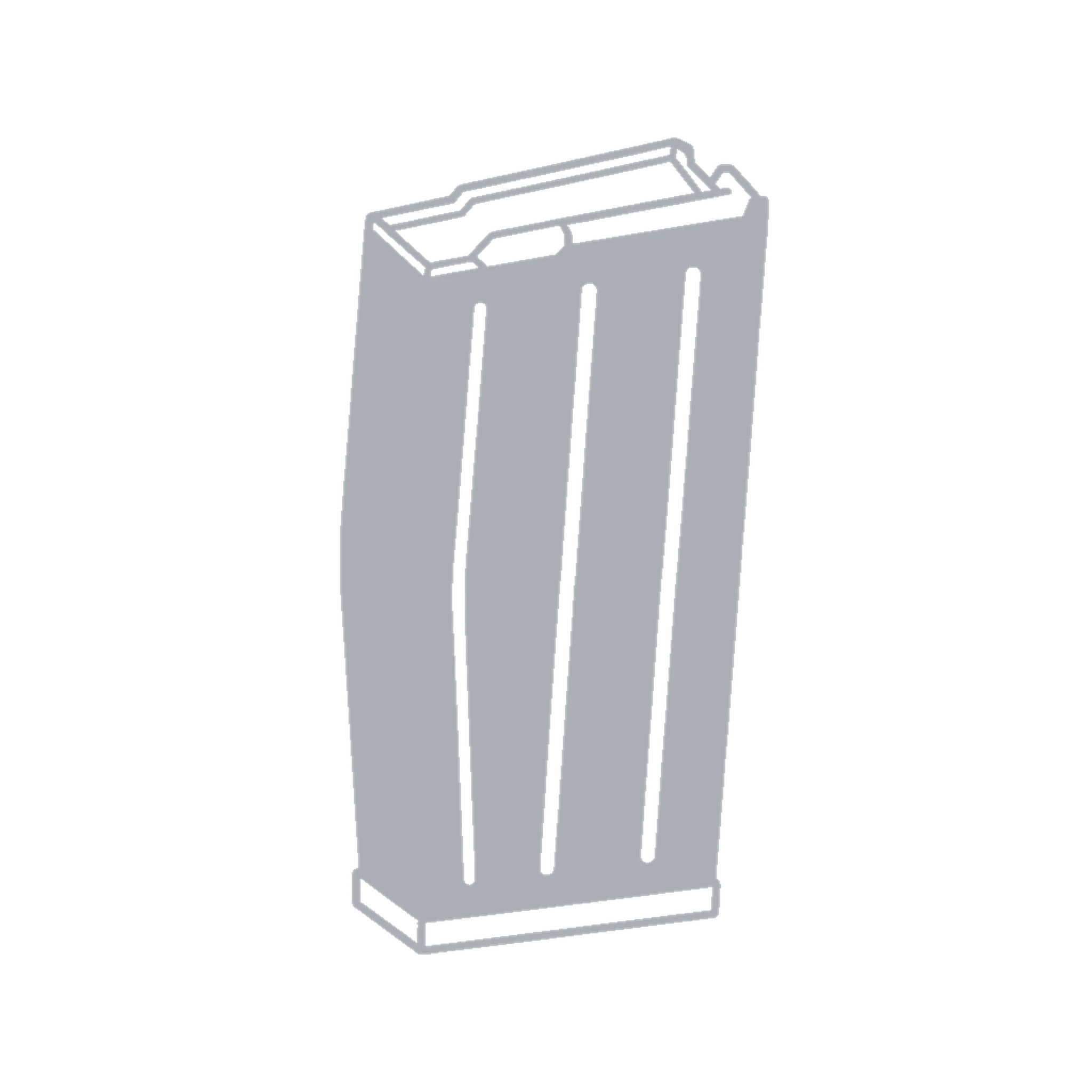 30 round banana magazine
 Adjustable rear sight
 Blade front sight
 Bayonet lug
 Sling swivels
- Lightweight design
Standing
How it compares
Each figure against the firearms of the same type and cartridge that record it, or of the same type where that cartridge has too few. Positions are read to the nearest tenth.
| Measurement | This firearm | Median | Position |
|---|---|---|---|
| Empty weightAmong 409 carbines | 2.60 kg | 3.00 kg | Lighter than about 80% |
| Overall lengthAmong 407 carbines | 905 mm | 895 mm | Longer than about 60% |
| Barrel lengthAmong 423 carbines | 458 mm | 406 mm | Longer than about 70% |
| Magazine capacityAmong 423 carbines | 30 | 21 | Holds more rounds than about 80% |
Answers
Questions about the M2 Carbine
How much does the M2 Carbine weigh?
The M2 Carbine weighs 2.60 kg (5.73 lb) empty and 2.95 kg (6.50 lb) loaded.
What caliber is the M2 Carbine?
The M2 Carbine is chambered in .30 Carbine.
How many rounds does the M2 Carbine hold?
The M2 Carbine holds 30 rounds, fed from a detachable box magazine.
How long is the M2 Carbine?
The M2 Carbine is 905 mm (35.6 in) long overall, with a 458 mm (18.0 in) barrel.
Who makes the M2 Carbine?
The M2 Carbine is made by Winchester Repeating Arms Company (United States). It was designed by Inland Manufacturing Division team (based on David Marshall Williams' M1 Carbine short-stroke piston action).
When was the M2 Carbine introduced?
The M2 Carbine was introduced in 1944 and discontinued in 1973.
How does the M2 Carbine operate?
The M2 Carbine uses a gas operated short stroke action, and its firing mechanism is hammer fired.
Compatibility
Which parts fit this firearm
Studio
Every part that mounts on this, resolved
Not a list the maker typed out: the answer comes from the mounts this firearm exposes and the interface each part needs, so it stays right when either one changes.
- Every part that mounts on any firearm in the catalogue
- Interface standards, platforms and fit overrides
- The same answers through the API and the MCP server
Requires a signed-in GunSpec account on the Studio plan. The answer is computed per part, so it is not part of the public record.


Provenance
What the record holds
Every figure above was taken from one of these pages. The confidence reflects how much of the record came from a page a claim can be checked against.
In service
- United States Army
- 1944
- United States Marine Corps
- 1945
- South Korean Armed Forces
- 1950
- Army of the Republic of Vietnam
- 1955
- French Armed Forces
- 1950
- French Foreign Legion
- 1950
- Israeli Defense Forces
- 1950
- Philippine Armed Forces
- 1946
- Japanese Ground Self-Defense Force
- 1954
- Taiwan Armed Forces
- 1950
Provenance
Stockists
Where to buy
Offers link straight to the shop. GunSpec never takes the order.
No shop has listed this firearm yet
Stock and prices come from the shops themselves. If you sell this firearm, you can list it and it appears here.
List a firearmMCP
Ask an assistant about it
The same record, reached the way a person asks for it rather than the way a program does.
Ask GunSpec
Works with
Point an MCP client at GunSpec and it answers from the catalogue rather than from memory. A free key covers the read tools.
API
The call that returns this record
The same fields, in the same units, from the same endpoint the page reads.
curl --request GET \ --url 'https://api.gunspec.io/v1/firearms/m2-carbine' \ --header 'X-API-Key: your_key'{ "id": "m2-carbine", "name": "M2 Carbine", "manufacturer": { "id": "winchester", "name": "Winchester Repeating Arms Company", "countryCode": "US", "foundedYear": 1866, "website": "https://www.winchesterguns.com", "logoUrl": null, "description": null, "status": null, "defunctYear": null, "stateOwned": null, "makesFirearms": null, "parentId": null, "predecessorId": null, "createdAt": "2026-02-11 23:44:38", "updatedAt": "2026-02-18 03:40:45", "version": "032f75658544de9d931ca09f772b9ab92b282bf53db67851bf4eb3f8c0612520" }, "category": { "id": "carbine", "name": "Carbine", "description": "Shortened rifles for close-quarters use" }, "country_of_origin": "US", "year_introduced": 1944, "barrel_length_mm": 458, "weight_empty_g": 2600, "action_type": "gas_operated_short_stroke"}